
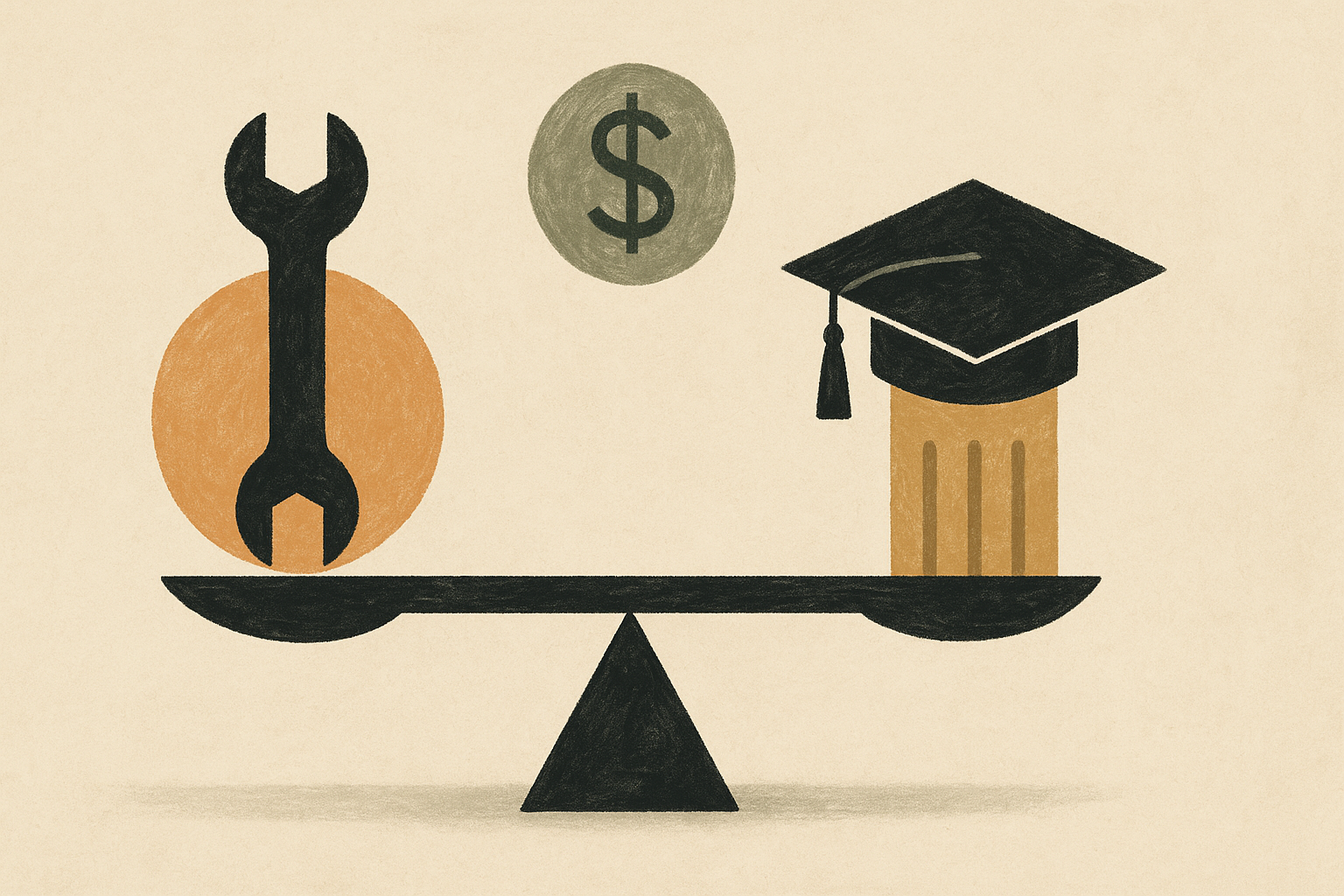
Standing in the parking lot after high school graduation, it’s not unusual to hear friends weighing student loan numbers against the promise of steady paychecks. Some are packing for four-year universities they can barely afford, while others eye six-month trade programs that could land them a job in less time than it takes to finish a single college semester. No one wants to waste time or money, but the pressure to choose “correctly” is real—and the stakes feel higher than ever as tuition and living costs keep climbing.
Breaking Down the Basics: Trade School vs Traditional College
It’s easy to fall into the trap of thinking there’s only one respectable route after high school, but both trade schools and traditional colleges offer valid paths—just with different timelines, price tags, and career outcomes. Understanding what each option actually involves is crucial before making any commitments.
- Trade schools: Also known as vocational or technical schools, these focus on hands-on training for specific careers—think electricians, HVAC technicians, dental hygienists, or welders. Programs typically last from several months up to two years.
- Traditional colleges: These grant associate’s or bachelor’s degrees over two to four years (or more), covering a broader range of academic subjects alongside major coursework.
- Alternatives: Online certifications and bootcamps have surged in popularity for fields like tech and healthcare, offering accelerated programs with flexible formats.
The right choice depends on your goals, finances, and appetite for risk—but let’s get specific about what you get for your investment.
Cost Comparison: Upfront Expenses and Hidden Fees
No matter how you slice it, education isn’t cheap. But the gap between trade school and college can be dramatic—even before factoring in lost wages during longer degree programs.
Average Tuition and Program Costs for 2025
- Trade schools: Most programs cost between $5,000 and $20,000 total. Some fields (like cosmetology or welding) may run lower; specialized healthcare trades can stretch higher.
- Public four-year colleges: The average annual tuition plus fees is projected around $11,500 (in-state), meaning a typical bachelor’s degree will easily top $46,000—before room and board.
- Private colleges: Sticker prices often exceed $40,000 per year. Scholarships help some students but don’t close the gap for most.
Add living expenses—housing, transportation, textbooks—and the math gets even starker. Trade school students generally spend less time out of the workforce too: many finish in a year or less versus four years at college. That means they can start earning sooner.
The Role of Online Programs and Bootcamps
- Bootcamps: Focused on skills like coding or IT support. Tuition ranges from $7,000–$20,000 with courses lasting three to nine months.
- Online certifications: Platforms like Coursera or edX offer professional certificates from under $500 up to several thousand dollars depending on industry and depth.
If cost is your top concern—or if you’re wary of debt—trade schools and short-term certification programs have clear advantages over conventional four-year colleges.
Salaries After Graduation: What Does Each Path Pay?
Earning potential is where people often hesitate about trade school: Will skipping college mean getting stuck with low wages forever? The data tells a more nuanced story.
Salaries by Education Path (2025 Projections)
- Vocational/trade jobs: Many skilled trades offer starting salaries between $40,000–$55,000 annually. Electricians ($60k median), dental hygienists ($77k), plumbers ($58k), HVAC techs ($51k) are all expected to remain in high demand through 2025 and beyond.
- Bachelor’s degree holders: Median starting salaries hover around $55,000–$65,000 depending on major. Some majors (engineering, computer science) command much higher offers; others (liberal arts) may trail behind certain trades.
- Coding bootcamp grads: Entry-level roles pay $50k–$80k depending on location and specialty—though competition can be fierce without prior experience or a degree.
The “lifetime earnings gap” between college grads and those without degrees is real—but it’s far narrower when comparing skilled trades against non-STEM bachelor’s degrees. In some markets (especially where trades are unionized), experienced workers out-earn peers with college diplomas.
The ROI Equation: How Long Until You Break Even?
No one likes debt hanging over their head for decades—so return on investment (ROI) matters just as much as headline salary numbers. Here’s how things shake out when you consider both costs and earnings potential over time:
- Trade school grads: With lower tuition bills and faster entry into the workforce (often within one year), many see positive ROI within two to three years post-graduation—even sooner if they avoid loans altogether.
- Bachelor’s degree holders: It typically takes six to ten years just to break even after accounting for higher costs and lost earnings during school. Graduates who take on significant student debt can face much longer payoff periods—especially if they enter lower-paying fields.
- Coding bootcamps/certifications: ROI can be rapid if you land a solid job quickly; however, outcomes vary widely by specialty and region. Some employers still prefer degrees for management-track roles.
This doesn’t mean college is always a bad investment—but it does underscore why so many people are rethinking what “success” really looks like after high school. A shorter path that leads directly to stable work can be a smarter financial move than chasing prestige at any cost.
Lifestyle Differences: Beyond Dollars and Degrees
The choice isn’t just about money—it shapes your day-to-day life for years to come. Here are some key considerations people often overlook when comparing these paths:
- Job security: Many trades are insulated from automation trends threatening office jobs; there will always be demand for electricians or medical technicians wherever people live and work.
- Lifestyle flexibility: Some trades require physical stamina or irregular hours; others offer regular daytime shifts with minimal overtime. On the flip side, white-collar jobs may provide remote work options but can blur boundaries between work/life balance.
- Lifelong learning: Both tracks require continued education—via licenses, online courses, or professional development—to stay current as industries evolve.
If you value working with your hands or crave visible results at the end of each day, trade school might fit better than another four years behind desks—or vice versa if you thrive on theory or want access to graduate study down the road.
Navigating Alternatives: Online Certifications & Hybrid Paths
A growing number of students skip traditional options entirely in favor of hybrid approaches combining online coursework with practical training or apprenticeships. These alternatives cater especially well to career changers and those already juggling family commitments or part-time work:
- Coding bootcamps: Popular among those aiming for tech careers without attending university full-time; many include job placement support upon graduation.
- Niche online certifications: From project management (PMP) to medical coding (CPC), targeted credentials open doors across industries—and signal commitment to employers even without degrees attached.
- Laddered learning models: Some community colleges now partner with local employers so students earn certificates first (for immediate employment) then stack credits toward an associate’s degree later if desired.
This modular approach keeps options open without locking anyone into multi-year commitments before knowing whether an industry fits their interests—and budget constraints.
Pitfalls To Watch For: What Gets Overlooked?
No path is perfect—and every option has its own risks. Here are some traps worth avoiding no matter which direction you lean toward:
- Poorly accredited programs: Not all trade schools or online certificates carry equal weight with employers; research job placement rates before enrolling anywhere.
- Lack of upward mobility: Some trades cap out below managerial pay grades unless you pursue further licensing or entrepreneurial routes.
- Mismatched expectations: College grads sometimes discover their chosen field doesn’t actually require a four-year degree—or that experience trumps credentials.
- Saturation risk in certain trades/fields: Local job markets matter—a glut of new electricians in one city could suppress wages while another region faces shortages.
- Dismissing ongoing education needs: Regardless of path chosen, upskilling through professional courses remains critical as technology reshapes nearly every industry.
A Practical Checklist For Deciding Your Best Path Forward
- Tally potential costs—including living expenses—for each education route you’re considering.
- Email local employers in your intended field(s) about which credentials they prefer.
- If possible, shadow someone already working your target job.
- If leaning toward college primarily “to keep options open,” investigate modular approaches like stacking certificates.
- If you need flexibility due to work/family obligations, compare online certification programs’ pacing versus classroom-based schedules.
- Create two sample budgets: one based on average starting salaries for your chosen path(s), another assuming six months’ unemployment post-graduation.
No one-size-fits-all answer exists here—the best route depends on your financial reality, personality fit for certain work environments, willingness to relocate if needed, and long-term goals beyond just initial paychecks.
The Bottom Line: Making An Informed Investment In Yourself
The days when everyone was pushed toward a four-year campus by default are fading fast—and that might be good news if you’re wary of debt or eager for hands-on work sooner rather than later. Trade schools deliver faster returns at lower cost in many fields; meanwhile, online certifications offer new ways into industries once restricted by expensive degrees.
If prestige matters less than stability—or if you want control over your education timeline—it’s worth looking beyond old assumptions as you plan for life after high school.
Whichever direction you choose—trade program, university campus, bootcamp cohort—the smartest move is making sure it’s actually built around your own priorities rather than someone else’s idea of success.